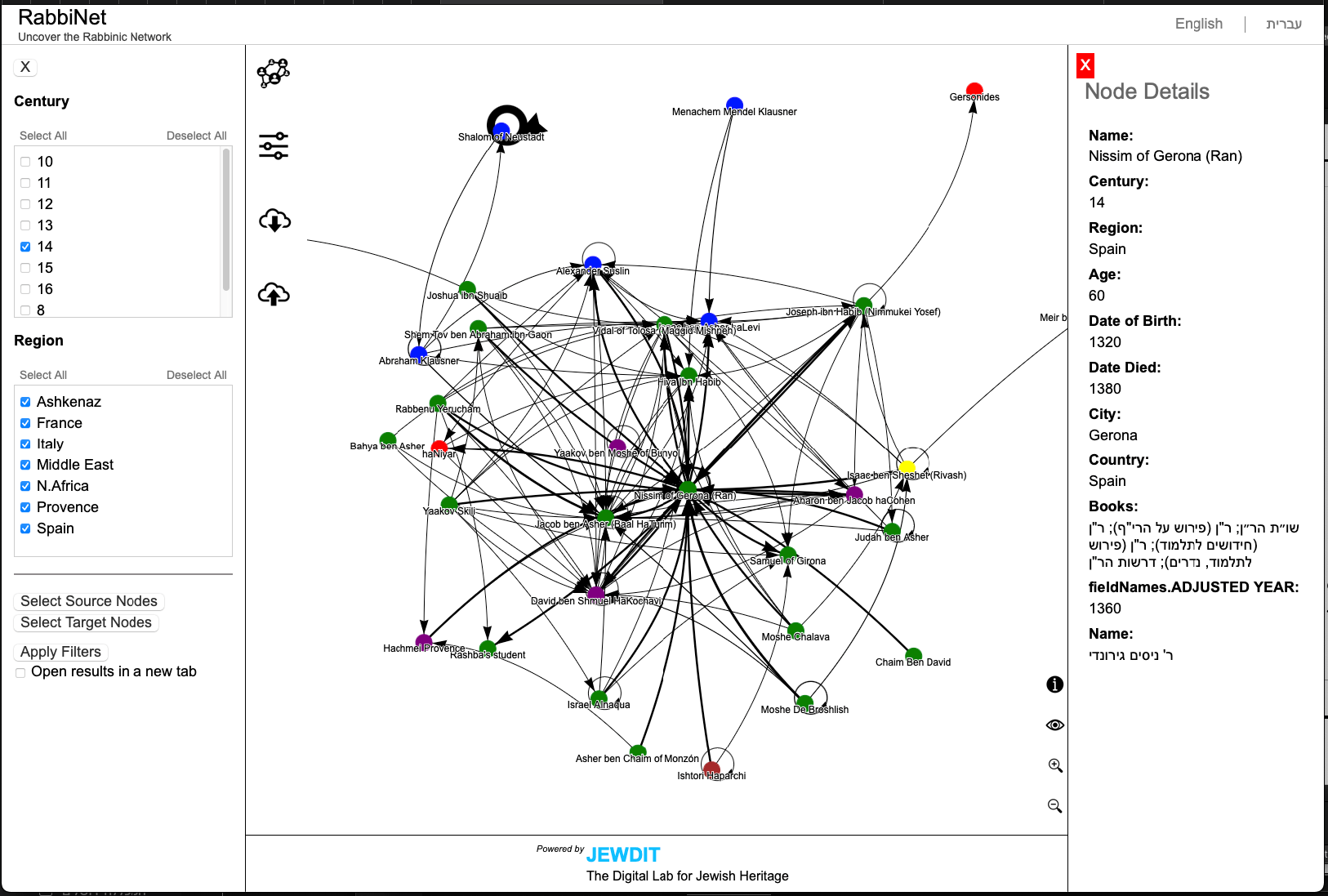
I am delighted to announce that I was awarded a National Endowment for the Humanities Collaborative Research Grant for three years to work on the project, “Knowledge Transmission and Cultural Interactions Through the Ages: An AI-Based Analysis of a Jewish Textual Corpus.” I will be working with a team in Israel (Binyamin Katzoff, Bar-Ilan University; Maayan Zhitomirsky-Gefet, Bar Ilan University; and Jonathan Schler, Holon Institute of Technology), who simultaneously received a grant from the Binational Science Foundation. The proposal abstract reads:
This project aims to advance our understanding of Jewish intellectual networks and cultural dynamics by conducting the first large-scale computational analysis of knowledge transmission across Jewish communities from 200-2000 CE.
Building upon recent advances in citation network analysis and computational methods for historical Jewish texts, we will analyze over 130,000 texts containing over 300 million words using advanced AI and Natural Language Processing techniques adapted explicitly for historical Hebrew and Aramaic sources. While previous studies have demonstrated the potential of network analysis for specific texts like the Babylonian Talmud or limited time periods, our project significantly expands this scope to examine cross-community intellectual exchange across eighteen centuries. The research will map citation networks and patterns of influence across multiple genres of Jewish literature, different geographic regions (from the Middle East to Western Europe), and various scholarly traditions,
revealing how knowledge and ideas spread, adapted, and evolved across different cultural contexts.By developing new digital tools for visualizing these complex networks of intellectual exchange, we will enable scholars to identify previously unknown connections between texts and authors, and study patterns of cultural adaptation across different communities. This project represents a significant methodological advance in the digital humanities, combining traditional Jewish scholarship with cutting-edge computational techniques to reveal new dimensions of one of the world’s longest continuous traditions of written scholarship, that can be applied also to other historical traditions.
There are essentially three goals of the project:
- To develop AI techniques and tools that abstract citations from an enormous and complicated corpus of rabbinic texts that span from antiquity to the modern day. These techniques should also be useful to scholars who similarly want to mine very different corpora to build their own citation networks.
- To use these extracted citations to construct a network, and then to develop a viewing tool that allows users to navigate (and filter!) this network.
- To begin the scholarly analysis of this network for new scholarly insights. We are especially interested in using it to trace how knowledge moves through space and time.
This project is a significant expansion of my work with Michael Sperling on the social network of the Babylonian Talmud. See also our more technical discussion of this project. It also intersects with a project that I’m developing on creating a citation analysis of the modern scholarly field of Jewish studies. I am excited and grateful to have the resources to continue this work.
The project is due to begin in October, 2025. We will need to work through a number of important questions (e.g., the exact corpus; how to use manuscripts; what counts as a citation) first. I anticipate hiring (on a consultant basis) both people with the technical skills to help us develop and refine AI tools and the viewer and those with expertise in rabbinic literature (and comfort with technology) who can help with the preparation, cleaning, and analysis of the data. If you are interested in joining the project, or in contributing and participating in other ways, please let me know.

