Uncategorized
A Full Citation Network of Jewish Legal Literature
I am delighted to announce that I was awarded a National Endowment for the Humanities Collaborative Research Grant for three years to work on the project, “Knowledge Transmission and Cultural Interactions Through the Ages: An AI-Based Analysis of a Jewish Textual Corpus.” I will be working with a team in Israel (Binyamin Katzoff, Bar-Ilan University; Maayan Zhitomirsky-Gefet, Bar Ilan University; and Jonathan Schler, Holon Institute of Technology), who simultaneously received a grant from the Binational Science Foundation. The proposal abstract reads:
This project aims to advance our understanding of Jewish intellectual networks and cultural dynamics by conducting the first large-scale computational analysis of knowledge transmission across Jewish communities from 200-2000 CE.
Building upon recent advances in citation network analysis and computational methods for historical Jewish texts, we will analyze over 130,000 texts containing over 300 million words using advanced AI and Natural Language Processing techniques adapted explicitly for historical Hebrew and Aramaic sources. While previous studies have demonstrated the potential of network analysis for specific texts like the Babylonian Talmud or limited time periods, our project significantly expands this scope to examine cross-community intellectual exchange across eighteen centuries. The research will map citation networks and patterns of influence across multiple genres of Jewish literature, different geographic regions (from the Middle East to Western Europe), and various scholarly traditions,
revealing how knowledge and ideas spread, adapted, and evolved across different cultural contexts.By developing new digital tools for visualizing these complex networks of intellectual exchange, we will enable scholars to identify previously unknown connections between texts and authors, and study patterns of cultural adaptation across different communities. This project represents a significant methodological advance in the digital humanities, combining traditional Jewish scholarship with cutting-edge computational techniques to reveal new dimensions of one of the world’s longest continuous traditions of written scholarship, that can be applied also to other historical traditions.
There are essentially three goals of the project:
- To develop AI techniques and tools that abstract citations from an enormous and complicated corpus of rabbinic texts that span from antiquity to the modern day. These techniques should also be useful to scholars who similarly want to mine very different corpora to build their own citation networks.
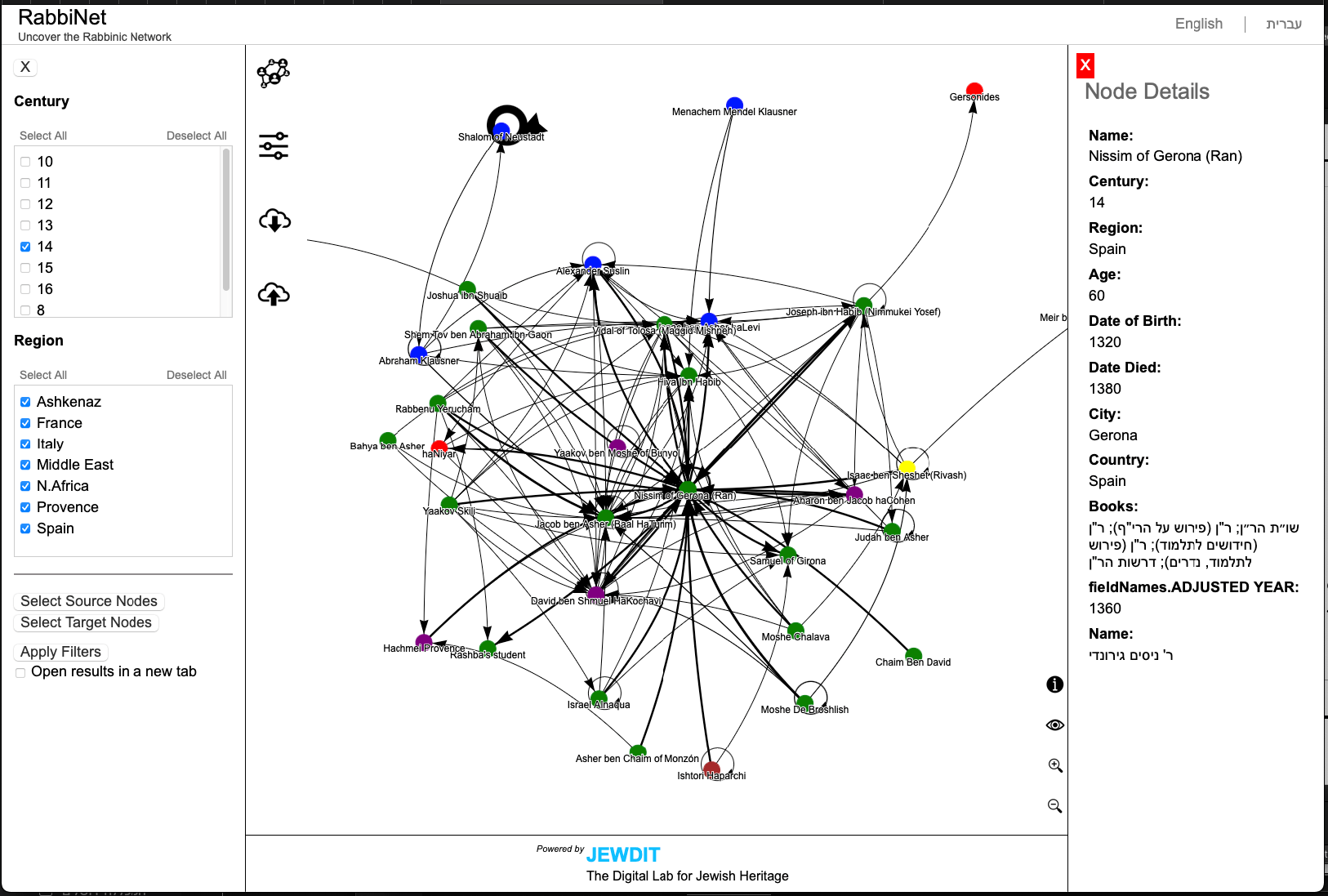
- To use these extracted citations to construct a network, and then to develop a viewing tool that allows users to navigate (and filter!) this network.
- To begin the scholarly analysis of this network for new scholarly insights. We are especially interested in using it to trace how knowledge moves through space and time.
This project is a significant expansion of my work with Michael Sperling on the social network of the Babylonian Talmud. See also our more technical discussion of this project. It also intersects with a project that I’m developing on creating a citation analysis of the modern scholarly field of Jewish studies. I am excited and grateful to have the resources to continue this work.
The project is due to begin in October, 2025. We will need to work through a number of important questions (e.g., the exact corpus; how to use manuscripts; what counts as a citation) first. I anticipate hiring (on a consultant basis) both people with the technical skills to help us develop and refine AI tools and the viewer and those with expertise in rabbinic literature (and comfort with technology) who can help with the preparation, cleaning, and analysis of the data. If you are interested in joining the project, or in contributing and participating in other ways, please let me know.
Relaunching “From Israelite to Jew”
In 2009-2010, I created a podcast, “From Israelite to Jew,” that traced the evolution of the Israelites and their religion to Jews and Judaism. The podcast covers the time period from around the seventh century BCE to the third century CE, the time approximately known as “Second Temple” period. My views have shifted somewhat, and today I am closer to the opinions I discuss in my book, How the Bible Became Holy (Yale University Press). Nevertheless, I still believe that there is merit to the podcast, and I’ve noticed that changes in the platforms I used have made it increasingly difficult to access.
For now, I am simply reposting the episodes to make them easier to access. They can all be found on this page.
Over the next few months I’ll be rereleasing them in batches. The series will thus be available on most popular podcast sites (e.g., Spotify). As I release them on these platforms, I will announce them on my blog and through my Substack. If there is sufficient interest and support, I will also occasionally add written updates and provide resources for them along the way. Also depending on interest and support (which can be given at my blog), I may even end up continuing it into the rabbinic period, and/or creating episodes that bring on other scholars to discuss these issues.
Word Similarity in the Talmud
At the beginning of the semester I assembled a team of students (Gabriel Burstyn and Songkai Zhao) to explore ways in which AI and machine learning can contribute to the academic study of early rabbinic literature. This is a burgeoning field and there are several others who have been doing interesting work in it, including Joshua Waxman, Ezra Brand, and Shlomo Friedman.
Much of our work to date has been exploratory. Part of that work has been technical: What can this technology actually do, and what are the most efficient ways to do it? The more interesting part of the work, though, is trying to understand how to apply these tools to academic questions. Can we use the technology to answer old questions or frame new ones? I have already taken a stab at this in a couple of articles co-authored with Michael Sperling on social network analysis (here and here) and another team has recently published an article that revisits an old question of Talmudic authorship using quantitative techniques (here).
Our first output is a tool that maps the similarity of word use in the tractates of both the Babylonian and the Palestinian Talmuds.
This is an experimental tool that uses machine learning techniques to show word similarities in the Babylonian and Jerusalem Talmuds. It will also allow you to compare how specific tractates use a word. It works by first mapping phrases (the length of which is determined by the “Window”) into a multidimensional matrix, then computing the distance between those occurrences, and finally sorting these occurrences into clusters based on the distances. The parameters are explained further in the menu. You can hover over the points on the visualization to see more data.
A similarity score of under 0.7 generally indicates that there is a likelihood of differing usage of the same word. We suggest that you begin with a K-Means and Hierarchical Cluster of “2” for exploratory purposes and then adjust from there.
Note that this presently works only with exact strings and you must use the Hebrew Unicode alphabet. So, for example, אמר and שנאמר are treated as two separate words.
To start:
- Enter the word you want to analyze.
- Choose a window size.
- Select the source (Yerushalmi or Bavli) for the chosen tractate(s).
- Select the desired tractate(s) from the dropdown menu.
- Click “Compare”.
Please note that the comparison may take 3 to 15 minutes to process. Comparisons of words that appear more frequently in the text may take longer.
The development of this tool has been supported by Brown University and the Center for Digital Scholarship at the Brown University Library. The texts have been downloaded from Sefaria and further refined by Michael Sperling. The code for this application can be found here: GitHub Repository.
You can access the tool here.
Is it useful? Well, we’re not entirely sure yet and that is why we welcome your comments. We have run a few proof of concept experiments. For example, we have looked at the term mincha in the Babylonian Talmud Berakhot (where we expect it to refer more to the afternoon prayer) and in Zevachim (where we expect it to refer more frequently to the sacrifice) and we did indeed find a high degree of dissimilarity as illustrated in the plot below:

On the other hand, we sometimes have found divergences that are harder to explain.
We encourage you to explore the tool and send feedback! We are currently working on expanding the tool to include stems and lemmas. At the same time, we’re exploring different applications that identify loanwords, locate texts by topic, and that map the citation network of academic Jewish studies. Updates as we have them.
Note that this is a different team than the one I blogged about previously (here) that is working on ancient inscriptions.
What Really Happened on Hanukkah?
Hanukkah is the only Jewish holiday not mentioned in the Jewish Bible. About four hundred years after the events that gave rise to the holiday, the rabbis were still uneasily puzzling about it:
The Gemara asks: What is Hanukkah, and why are lights kindled on Hanukkah? The Gemara answers: The Sages taught in Megillat Ta’anit: On the twenty-fifth of Kislev, the days of Hanukkah are eight. One may not eulogize on them and one may not fast on them. What is the reason? When the Greeks entered the Sanctuary they defiled all the oils that were in the Sanctuary by touching them. And when the Hasmonean monarchy overcame them and emerged victorious over them, they searched and found only one cruse of oil that was placed with the seal of the High Priest, undisturbed by the Greeks. And there was sufficient oil there to light the candelabrum for only one day. A miracle occurred and they lit the candelabrum from it eight days. The next year the Sages instituted those days and made them holidays with recitation of hallel and special thanksgiving in prayer and blessings. (Babylonian Talmud, Shabbat 21b, translation sefaria.org)
This is basically extent of rabbinic interest in the history of Hanukkah (although they do say more about the Hasmonean kings – who they basically didn’t like – and the contemporary ritual of lighting candles on the holiday).
Fortunately, there are a few other sources that add to our historical knowledge. The two books of the Maccabees in the Apocrypha are our most complete source. 1 Maccabees and 2 Maccabees are themselves not fully consistent and were clearly written in different times and places for different purposes. The historian Josephus provides another, later account, that is largely derivative from the books of the Maccabees. There are a handful of other sources that throw light on various aspects of the events (I especially like this inscription, which attests to the evil king Antiochus), but the end result is that a more complete understanding of the so-called Maccabean Revolt is elusive and has been the subject of continuing scholarly controversy.
Some years ago I created a podcast, “From Israelite to Jew,” in which I devoted one of the episodes to a (not necessarily the only, or even best) historical reconstruction of the events leading to the Maccabean Revolt (ca. 164 BCE – 162 BCE). I am re-upping that episode here. I hope you enjoy it.
Happy Hanukkah to all those celebrating!